
Awake before dawn, I watch the full moon slide slowly into the western horizon on the first full day of winter. Yesterday afternoon my husband and I honored the Solstice with only a nod and a brief prayer of gratitude for the return of the Light, instead of our usual Day of Silence, because our electrician had not yet finished wiring our new hot water heater. We’ve chosen an electric one, because our home has just become wholly powered by the sun. Our decision to go solar is based on our trust that the sun will, of course, continue to come every single day.
Not long after the moon sets, I watch that daily miracle happen again, when the eastern horizon gives birth to Light. I pray my thanks that the sun never forgets to bring us its gifts and I ask it to illuminate my heart as it illuminates the world (not to mention my solar panels). Tonight the sun will disappear before five. I won’t cry as it goes, as I didn’t cry when the moon left this morning, because, of course, I know they always return.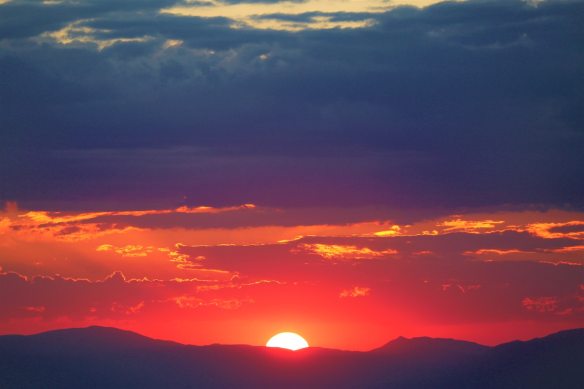
When we say, “The sun didn’t come out today,” it’s never fully true, because even in the cloudiest weather the sun still lights our way. In these short December days, I know spring will come—early or late—spring and then summer and then fall and winter again. These diurnal and seasonal cycles, like our own breath coming in and out, teach that everything is in constant change and motion and that everything returns; that which goes away is not lost forever.
My grandparents, my parents, my younger daughter Randi, too many of my friends, three of my sisters-in-law, and four of my cousins have all sunk beyond the horizon, out of sight, if not out of mind and heart. I have cried for each of their deaths and some I will cry for again and again, longing for a hug, a conversation, a card, a walk together in the woods.
Nature reminds me on a daily, monthly, yearly basis to express my gratitude to these beloveds, even as I cry and mourn their absence, for nothing and no one ceases to exist. They can and do receive my love and someday, someplace, even though I don’t know where or when or how, they will rise and return just as the sun and the moon do.
The Winter Holy Days are upon us—Thanksgiving and The Prophet’s Birthday and Hanukkah and the Solstice have passed, Kwanzaa and Christmas and New Year’s Day and Three Kings Day are coming, as they always do. I hold a place in my heart for the absent. I light a candle for the absent. I include my joys and my griefs and my beloveds—living or not—in everything I celebrate.
I raise a toast to those I love.
May you do the same.
May your Holy Days be wholly blessed.
Here are links to a couple of my new podcast interviews:
with Rob McConnell of Xzone Radio: https://bit.ly/2V90rtx
with Connie Whitman of Architect of Change: https://bit.ly/2LzVfdK
You may buy The After Death Chronicles: True Stories of Comfort, Guidance, and Wisdom from Beyond the Veil in bookstores, through www.AnnieMattingley.com and through the following sites:
Amazon: http://amzn.to/2zSaTLB
Barnes & Noble: http://bit.ly/2ljjV0I
Indie Bound: http://bit.ly/2gEcr3f





 I am writing this on Halloween while the ghosts and goblins and ghouls are roaming about. Little is more fun than dressing up in costumes, but the haunted houses and fright masks and scary guys emerging from coffins distort the sacred meaning and history of this season.
 I discovered this opening quite by accident on an autumn vacation in Oaxaca, Mexico. Inspired by their Muertos festivities, I created a makeshift altar with a few candles, and some marigolds (the traditional flower of the dead) from the flower stalls at the Veinte de Noviembre Market, and one of Oaxaca’s famous sugar skulls. I used my travel sewing kit to represent my mother, a tourist brochure for my magazine publisher father. Once I lit the candles, the quality of sacredness was palpable. Though the signs were subtle, I was pretty sure I felt the presence of my parents, a first. Then came the real surprise—though I had done nothing consciously to invite it—the definitive presence of the baby I had aborted years earlier. When she (I had never known her gender!) reassured me she was all right, I was not only astounded by the visitation, but also by how much it comforted me, since I thought I had long ago made peace with my choice.
 To illustrate just how seriously Mexicans take their altars, I’ll tell you about another year I was in Oaxaca for Muertos. My Mexican son-in-law Emiliano had left for his home village before my arrival, because his father was ill. My daughter Rowena and I had already put up the altar when we got the call that his father had died. She and my grandson left at once to join Emiliano. On their arrival, his tias, his aunts, looked worried. “Who’s minding the altar?” they asked. When my daughter replied, “Mi madre,” the tias smiled and sighed with relief. To have simply stopped lighting those candles when a significant death was so fresh was unthinkable. Perhaps at any time mid-Muertos, it would always be unthinkable.
 Annie Mattingley