

“Randi’s Estate and Taxes—Toss January 2019” I’d written on the top of the box. On the side I’d taped a blown-up photo of a monarch butterfly, so I wouldn’t have to read that sad reminder every day in my closet. I’m quick to sort and shred and toss; I don’t like things hanging around beyond their useful life. The accountant and the lawyer had told me when these records could be tossed and I needed the space in my closet, yet sorting—what to shred, what to recycle—made a thousand tiny paper cuts in my heart. I didn’t cry, but I ached, as if it were my daughter Randi I was letting go of, not a stack of outdated papers.
From conception to death we continually cling and let go. In the womb we cling to the umbilical cord, letting go at birth to breathe for the first time on our own, when we still must cling to our mothers in order to survive. There is a letting go when we leave our childhood homes, but the urge to cling challenges us the most around our own deaths and the deaths of our beloveds. 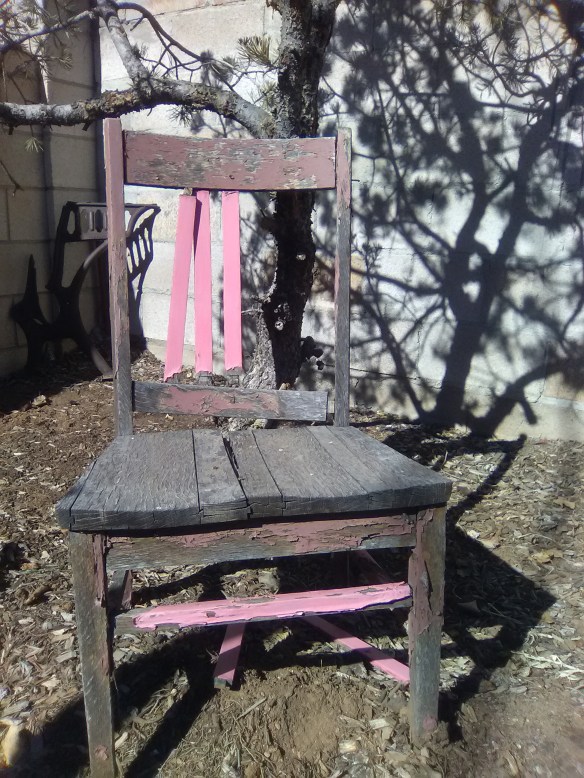
This winter a new challenge has emerged for me. The chair I had long ago placed in the backyard to honor Randi as a symbolic invitation for her to visit (see my very first blog, A Chair for the Dead, May 8, 2017) is slowly disintegrating. First one slat loosened, then another and another, now the first two have fallen to the ground. Each morning, I study the chair to see what has changed overnight. The paint’s been peeling for years. The seat has warped. None of this makes me cry, but that ache comes once more. It seems I thought this chair would last forever. Why do I cling to a warped wooden chair that’s been rained, hailed, snowed, and sleeted on, not to mention bombarded with our intense high desert sun, for more than eight years? Of course, I could repair it with glue and screws and paint, but wouldn’t that just be another way to cling to sadness?
Standing together at the window I tell my husband, “I know the chair’s a mess, but please don’t toss it.” I stop myself from adding yet. At what point will this symbolic object become trash? Unsure what I will do with it when it is rubble, I simply watch my reactions to its decline.
As I write I imagine one of the neighborhood mourning doves on the chair and it crosses my mind to write that I’d seen one, when I had not. After all, there’s bird poop on the seat, so it makes sense, but I’m mortified by my unethical thought. This blog is not fiction, it’s reality. I get up to wipe that dumb idea away with some hot ginger tea. On the way back to the page, just as I glance out the window, a mourning dove lands on the chair and I gasp as it preens in the sun and ruffles its feathers.
You would think with all the after-death communication experience I’ve had and heard and written about, I would get that this is Randi, but I don’t at first. I am crying though and suddenly joy-filled, because I know what to do with the chair. In the spring, I’ll put a birdbath on it or on its remains. I’ll get to watch birds playing in the water, shaking drops from their wings, scuffling, and splashing. It is now that I finally realize this is Randi making one more visit—the only one I’ve ever seen on her chair. I laugh aloud at the play on the word “mourning,” and at how she, and so many of the dead, love puns and word play. Without a single word, my daughter has reminded me to focus on playfulness rather than cling to pain. 
The next few days are particularly sunny and warm for February. I keep going into the backyard, finding pretty objects to put near the chair. I discover a way to mount my blue bottles there, smiling as I recall how Randi and I share a love of cobalt blue glass. Now in the morning, when I open the curtain, my eyes are drawn first to how the sun casts shadows on the blue bottles. I notice I often don’t even think to check the chair. I am letting it go.
You may buy The After Death Chronicles: True Stories of Comfort, Guidance, and Wisdom from Beyond the Veilin bookstores, throughwww.AnnieMattingley.comand through the following sites:
Amazon: http://amzn.to/2zSaTLB
Barnes & Noble: http://bit.ly/2ljjV0I
Indie Bound: http://bit.ly/2gEcr3f
Hampton Roads/Red Wheel/Weiser: http://bit.ly/2gM255a
https://youtu.be/W5bp1BrZGq4is the link to the video of a panel discussion, with me and three others, on the question: “Is There Life After Death?” We have since formed a group, Women Who Know—Death is Not Final, available for keynote talks, panel discussions, and workshops. For more on this, contact me through mattingleyannie@gmail.com.

 After my recent move from a home with delicious well water, I discovered that my new town fluoridates its water and my nice under-sink water filter didn’t remove fluoride. I added replacing the filter to my to-do list, but my mother, dead since 1984, wasn’t satisfied. She showed up the next morning, not with her usual tingle up my right side but with jackhammer force, to urge me to deal with this quickly—for both my health’s sake and my husband’s. That day we began buying water. If I have learned nothing else from after-death communication, it is that our beloved dead look out for our well-being and it’s best to heed their advice.
 What happened to Calvin two years after his stepson’s death was not quite so clear-cut. Coming from the gym late one night he chose the long way home, one he wouldn’t choose “ninety-nine times out of a hundred.” Then he heard his stepson’s voice say, “Good choice, Dad.” Was it he who nudged Calvin to take this route and did this prevent catastrophe? He may never know, but his wife’s experience had taught him to trust this as a possibility. To encourage such support this is a good point at which to acknowledge it with an audible thank you.
 Calvin added a story of synchronicity, telling me that twenty-five years ago, he dreamed of one of his children—he couldn’t tell which one—in a casket; in the dream it was 4:44 am. Much later, and eighteen years apart, the calls to inform him of his daughter’s and stepson’s deaths both came at exactly 4:44 am. Where do we file such events? Do they occur just to jolt us out of the narrowness of our blinkered everyday view into the great mystery of larger possibilities?
 To access my podcast conversation on after-death communication with Connie Whitman, Architect of Change, click on:



 Annie Mattingley