
Tiny Ways to Honor the Dead


Doing something to honor a person we love who is no longer in a body pleases the heart and satisfies the soul. It is a kiss through the veil. Activity is natural to us. We miss our regular acts of service and love—making a meal, sending a card, buying a gift, placing a phone call. Death stymies us. At every turn we face a detour sign that blocks our natural impulse to connect.

Of course, we honor our dead in traditional ways like headstones and crypts and arrays of flowers. We endow scholarships, fund benches in parks, start charitable foundations, dedicate books (that’s me). There are also really personal ways that can ease the sting of our thwarted impulse to connect. Here’s one that arose spontaneously for me.

As I was preparing to take down an unhealthy tree on the far edge of our land I noticed how sculptural its bare branches looked. I stood back, wondering, if I left the rest standing, how turn it into an art project. Over lunch I asked my visual artist husband what he might put on this tree. “I’ll think of something,” he said. “I’ll add it to my list.” I wanted something that could happen in the next hour.

Suddenly my deceased daughter’s sun-hats came to mind. A bag of them had been sitting on a shelf for a couple of years. I counted them. There were thirteen hats. I went out to the tree. It had thirteen branches.

That’s how Randi’s Hat Tree came to be. It has no plaque. It pleases me that her hats make passers-by laugh. You won’t count thirteen hats in the photo though. Some have been sacrificed to snow and wind. The rest are drooping and shredding and fading. One branch has broken off. Within a few years there will be no more hats. I find this temporary quality gratifying. It’s our love that lasts. I don’t need a marble monument to remind me of that.

Here are a few ideas for what you could do in the name of a dear dead one:
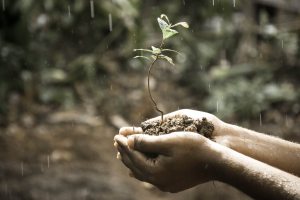
Plant a tree, a rose, a wildflower bed. Watch it grow, wither, and bloom again in the spring.

Give a quarter to a homeless person. Say, “This is from my mother…”

Offer up today’s practice—prayers, mantra, meditation—to honor someone beloved.

Balance a pebble on a fencepost as you walk by.

Put up a birdhouse.

Spend ten minutes weeding the library’s flower bed

Walk to the corner and back again as a gift to your beloved.

In what tiny ways have you honored someone? If you try some of my ways, what was it like when you saw that pebble on the fencepost the next week? Or when bluebirds nested in the birdhouse? Or the next time you saw a homeless person? Did any of this ease the sting of a moment’s grief? What happened over time?  I’d love to have you share these on my website at www.anniemattingley.com.

The After Death Chronicles: True Stories of Comfort, Guidance, and Wisdom from Beyond the Veil. To be released by Hampton Roads on October 6, 2017. Pre-order on AmazonBarnes & Noble, and IndieBound. Find out more on my Book Page.


Vera, a Mystical Film

Blog. Blogger. Blogging. How many times did I hear these words before I had any clue what they meant? Blog made me think of glop and glop took me back to eggplant glop, the name my family gave to a gooey, cheesy dish my daughters would beg me to make when they were young. Yet here I am writing a new blog every week, so who says an old dog can’t be taught new tricks? I refuse to describe myself as a blogger though, any more than I was a glopper back then.

In the early 2000s, when I first saw the film Vera  (www.facetsdvd.com) presented by its Mexican director Francisco Athie at the Taos Talking Picture Festival, I was mesmerized. This visionary film depicts the journey from life into death of an old Maya man. He is a miner who dies in an accident, though neither the old man nor I realize this for quite some time. Lest he lose his way on his journey, a guide—Vera—appears to escort him across.

Vera is so ethereal, so unearthly it’s difficult to get that she is actually played by the living, breathing Japanese actress and Butoh dancer, Urara Kusanagi, rather than by some being created in an animation department. In a boat that slides silently through underground passages, Vera transports the man from the mine into the land of the dead with the utmost gentleness and love. One could never hope for more supportive assistance.
This is the thrust of the story. You must see the film to feel its magic, the pace slow and lyrical as poetry. It is in Mayan and Spanish. There are English subtitles, but there is so little need for language they seem almost irrelevant.

Though the film is fictional, it aligns perfectly with accounts from the dying and from near-death experiencers. Vera is also reflective of the peace that emits from those dead who communicate through the veil that separates life from death.

I remember how cold my mother’s feet became and then her legs, hours before her last breath. She seemed to die from the toes up. Yet even before that, she lost her desire to open her eyes and look at life, to speak, to drink, to eat. To please my sister, she took one bite of her daughter’s homemade pumpkin mousse on Thanksgiving, but that she did out of love not hunger.

I was interrupted just now by a phone call with the news of the death of a distant relative in her late eighties, who had been failing for a while. She died at home, her family at her bedside. Last week, when she refused dialysis, her dying began in earnest.

Certain doctors, especially those involved in the cutting edge work of resuscitation medicine, are beginning to understand that the body’s last breath is only part of a complex process. Beloveds, as well as hospice workers—nurses, doctors, orderlies, and palliative care therapists alike—get to see before-death experiences where the dying address people unseen by others. Those who die briefly and are resuscitated tell of what lies beyond death. In the middle of this rich texture is that point which modern medicine calls the moment of death.

The whole process, emotionally draining as it usually is for those left behind, is a sacred one, replete with a sense of mystery that Vera ably portrays.

The After Death Chronicles: True Stories of Comfort, Guidance, and Wisdom from Beyond the Veil. To be released October 6, 2017. Pre-order on AmazonBarnes & Noble, and IndieBound. Find out more on my Book Page.

Three Reasons Why After-Death Communication Matters

We humans crave meaning in our lives. Contact with our dead beloveds can fulfill that desire in several manners. The most obvious way is that it relieves grief, but this is not its sole purpose. What I’ve found through my personal experience and research and interviews is that besides offering the bereaved comfort and hope, after-death contact can reduce fear of our own deaths and demonstrate that consciousness continues beyond the grave.

Hearing my daughter’s voice a few weeks after her suicide instantly released the hundred pound sack of worry for her that hung from my heart. She didn’t have to tell me she was okay. The very sound of her voice let me know she was all right.

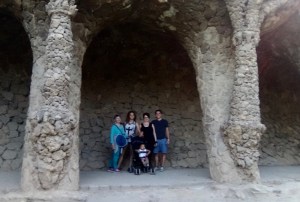
Me and My Family at Park Guell in Barcelona

During the three fabulous weeks I just spent in Spain with my family I saw how often my great-granddaughter cried like she’d lost her forever when her mom left the room. She’s the one in the stroller in the photo taken at Gaudi’s Park Guell in Barcelona.

This is exactly how we react when beloveds die, convinced we will never see them again. Our bodies ache, our hearts break, our minds dull. If we hear or see or feel their presence again, this process is not halted. But if we have some contact through the veil, the edges of our grief can be muted and softened once we grasp that on a non-material basis this person is still available to us.

This realization helps us to deal with a profound mystery: what will happen to us when we die? Most of us range along a continuum from nervous to terrified about that question. Do we simply fall into an abyss of nothingness? Is there a heaven or a hell? Are we worried that our flaws and mistakes will be judged? Will we be “sent” to that heaven or that hell?

Despite all the words of praise spoken in eulogies, our dead beloveds are most likely as imperfect as we are. When they return to tell us they’re okay, sometimes surrounded by a light so transcendent earthly words are inadequate to describe it, it helps us to understand that death is neither an empty abyss nor some horrific place to be feared.

Once we open ourselves to the possibility of death as a continuation, as another kind of existence, we are brought face to face with another large question: Who am I? Because we are so bound to our bodies, we are challenged to understand that we are more than physical beings.

I like to use the word consciousness to describe our essential nature, that part of us that does not die, that cannot die, that existed before birth and will exist after death, that part of us that does not require a physical body in order to be. You may be more comfortable using other words like soul or spirit to describe that essence.

Because I have seen these results manifest so profoundly in those who have had contact with dead beloveds, I view these moments as packed with possibilities. Whether we experience a single instance or, as I have, innumerable contacts, if we are willing to examine and explore the deeper meaning that underlies these experiences, we open ourselves to the mystical realms.

This can add a dimension of satisfaction and joy and relief from anxiety that frees us up to live life more fully. In these three ways—grief relief, less fear of death, and awareness of our essential nature—after-death communication can evolve into one of life’s great gifts.

The After Death Chronicles: True Stories of Comfort, Guidance, and Wisdom from Beyond the Veil. To be released October 6, 2017. Pre-order on AmazonBarnes & Noble, and IndieBound. Find out more on my Book Page.

A Chair for the Dead

An odd little chair used to sit in the corner of my weaving studio, more in the way than useful. I can’t recall how it came to be ours, but someone had cut down its legs so most people found it way too low, though it fit my five-foot frame perfectly.

When I read about the practice of placing an old chair in the yard as an invitation to include a deceased family member in our ongoing lives, I took this chair out near our picnic table for my deceased daughter Randi. Later I moved it away from easy view under the shade of a huge juniper tree. The next summer I sat beside it often as I wrote. Somehow it was solace just to be near that chair.

The backstory of this practice began in the 19th century, post-Civil War southern United States where African-Americans, many of them former slaves or their descendants, had a long history of suppression of their cultural and artistic expressions. Not to be restrained, they found a way to create art in their yards from cast-off objects that appeared, to outsiders, to be just plain old junk.

This junk has hidden meanings encoded into it like a secret language and yard art is often used to commemorate beloveds who have died. What looks like only a wrecked pedal sewing machine rusting away in the rain, to the family honors their grandmother. An assemblage of broken-handled shovels and rakes, a blackened wrench, half a pair of pliers lying about in an apparently random pile may have been carefully arranged as a memorial to a hardworking father.

And a chair, with its cane seat sagging or broken rungs or wobbly legs, is an invitation to a beloved’s spirit that says, “You are welcome here. We love you. We still heed your words and your wisdom.”

Nestled up against our latilla fence, Randi’s chair could be seen from half my house. I worried that someone might sit in it, though no one ever did. It stayed there for a year, until I felt called to move it further away. I wondered if I was putting it in the shade to protect my daughter’s fair skin, as if that could matter to her anymore. Now I can’t see the chair without deliberately visiting it, which I did frequently at first and seldom do anymore. I’ve noticed its paint is peeling. This all seems to reflect the evolution of my grieving from a constant and pressing awareness to a more occasional one.

I like the secrecy of the language hidden within this chair. I like that no one asks why it’s there, that it’s simultaneously public and quite private. It holds another layer of secret meaning as well. Because of its African-American roots it honors the multi-racial mix of our family. I am Caucasian, as was my daughter. This chair commemorates her choice to partner with an African-American man and the mixed-race arm of our family line they began together.

If you have ever driven through the southwestern United States you may have seen small white crosses along the highways. Some are elaborately decorated. Some have names or dates painted on them. These crosses are called descansos (descanso means “rest” in Spanish). Each one commemorates someone who has died in an automobile accident, yet another way of honoring the memory of the dead. It is touching to drive by as families gather to refurbish these crosses or to add a circle of stones.

We humans want and need to maintain connection with and to honor those who have died. My personal experiences and the research for my book show me that the dead also want to keep in contact with us. Whether we put an old rocking chair in the yard or a small pebble by our apartment door or a descanso by the road, any of these can help to keep the connection with a dead beloved strong.

The After Death Chronicles: True Stories of Comfort, Guidance, and Wisdom from Beyond the Veil. To be released October 6, 2017. Watch for pre-ordering in July. www.anniemattingley.com