Three Reasons Why After-Death Communication Matters

We humans crave meaning in our lives. Contact with our dead beloveds can fulfill that desire in several manners. The most obvious way is that it relieves grief, but this is not its sole purpose. What I’ve found through my personal experience and research and interviews is that besides offering the bereaved comfort and hope, after-death contact can reduce fear of our own deaths and demonstrate that consciousness continues beyond the grave.

Hearing my daughter’s voice a few weeks after her suicide instantly released the hundred pound sack of worry for her that hung from my heart. She didn’t have to tell me she was okay. The very sound of her voice let me know she was all right.
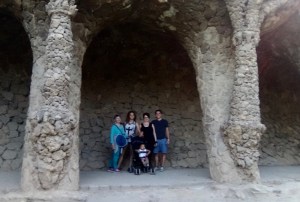
Me and My Family at Park Guell in Barcelona

During the three fabulous weeks I just spent in Spain with my family I saw how often my great-granddaughter cried like she’d lost her forever when her mom left the room. She’s the one in the stroller in the photo taken at Gaudi’s Park Guell in Barcelona.

This is exactly how we react when beloveds die, convinced we will never see them again. Our bodies ache, our hearts break, our minds dull. If we hear or see or feel their presence again, this process is not halted. But if we have some contact through the veil, the edges of our grief can be muted and softened once we grasp that on a non-material basis this person is still available to us.

This realization helps us to deal with a profound mystery: what will happen to us when we die? Most of us range along a continuum from nervous to terrified about that question. Do we simply fall into an abyss of nothingness? Is there a heaven or a hell? Are we worried that our flaws and mistakes will be judged? Will we be “sent” to that heaven or that hell?

Despite all the words of praise spoken in eulogies, our dead beloveds are most likely as imperfect as we are. When they return to tell us they’re okay, sometimes surrounded by a light so transcendent earthly words are inadequate to describe it, it helps us to understand that death is neither an empty abyss nor some horrific place to be feared.

Once we open ourselves to the possibility of death as a continuation, as another kind of existence, we are brought face to face with another large question: Who am I? Because we are so bound to our bodies, we are challenged to understand that we are more than physical beings.

I like to use the word consciousness to describe our essential nature, that part of us that does not die, that cannot die, that existed before birth and will exist after death, that part of us that does not require a physical body in order to be. You may be more comfortable using other words like soul or spirit to describe that essence.

Because I have seen these results manifest so profoundly in those who have had contact with dead beloveds, I view these moments as packed with possibilities. Whether we experience a single instance or, as I have, innumerable contacts, if we are willing to examine and explore the deeper meaning that underlies these experiences, we open ourselves to the mystical realms.

This can add a dimension of satisfaction and joy and relief from anxiety that frees us up to live life more fully. In these three ways—grief relief, less fear of death, and awareness of our essential nature—after-death communication can evolve into one of life’s great gifts.

The After Death Chronicles: True Stories of Comfort, Guidance, and Wisdom from Beyond the Veil. To be released October 6, 2017. Pre-order on AmazonBarnes & Noble, and IndieBound. Find out more on my Book Page.

Does Death Transform Us?

Whatever else occurs in the mystery that is the afterlife, growth is a key aspect.

A year following his death, Helena’s father, too reserved to be close to his daughter when alive, sat down beside her in a dream. He had two forms. He was both himself (so she recognizes him) and a huge white mountain. She knew that his true form was the mountain. When he told her not to worry—about him or about anything, she was filled with ecstasy. This replaces everything between them, she told me, and is the “true nature of our relationship.”

© creativecommonsstockphotos / Dreamstime Stock Photos

Something happens when we are no longer in our bodies, no longer stuck in the negative aspects of our personalities. The dead mature, African shaman Mandaza Augustine Kandemwa says, in the book Twin from Another Tribe, he co-authored with Michael Ortiz Hill.

Many of those I interviewed during the research for my book on after-death communication experienced contact with the dead who had shifted from belligerence, rage, or alcoholism into benevolent and loving parents or siblings or partners. Forgiveness arose. Selfishness fell away, though sometimes this took years. An abusive father came in a dream long after death, ready to support his daughter for the first time and expressing his admiration for her.

At times this transformation must occur within the living too. My parents died in 1984. Large components of healing occurred among us just before their deaths, but I clung to certain resentments. Gradually, as I matured, these faded, so that now I feel only enormous appreciation for their gifts; their human flaws seem negligible.

For fifteen years Carla’s father’s Alzheimer’s had kept her from receiving the emotional support she longed for. She scheduled a psychic reading when she had no idea he would soon die. Her session, after his death, was flooded with his presence and support and love. After that, as though his dementia had never been, his reassurance and advice seemed always available to her. He helped her with issues involving her divorce; complex situations were resolved just as he said they would be. Carla told me her father gave her “the strength and perspicacity to do what I needed to do.”

Dementia and diseases like Alzheimer’s are of the physical body and brain. Once they are out of the picture, the essential nature is free to rise.

This quality of our true nature that emerges after death is best summed up with the single word “loving”. We humans can be quick to anger, to judge, to resent, and to wound those we love the most. The nature of loving in the afterlife, as indicated by both after-death communication and near-death experiences, excludes anger, judgment, resentment, and hurt. Only love matters to them now. Anything else is “nothing more than a row of pins” as one deceased husband told his wife when she worried about something she had done.

It is nearly universal for any direct connection with the afterlife to demonstrate this absolute and unqualified love. In fact, these visceral demonstrations of untainted love may be the primary gift of our contact with the dead.

Reading or talking about unconditional love is not the same as feeling its effects. Our response to such love is like a thirsty plant’s response to warm rain. We flourish under its presence and we are taught how to live and love more fully with each contact.

The After Death Chronicles: True Stories of Comfort, Guidance, and Wisdom from Beyond the Veil. To be released October 6, 2017. Watch for pre-ordering in July.
www.anniemattingley.com

So Many Ways to Grieve

Mirabai Starr is a local writer acquaintance whose daughter died nine years before mine. I read her most recent book, a memoir, Caravan of No Despair (www.mirabaistarr.com), just before the fifth anniversary of my daughter Randi’s suicide, then set the book aside.

Recently I went to retrieve the manuscript for my own book The After Death Chronicles after Mirabai had read it. I felt chagrined when she referred to my knowing about her daughter’s after-death contact from her book, because I could not remember this. Eighteen months after my first reading, I read Caravan of No Despair again.

Now I could see how unprepared I had been for reading about her grief process and her daughter’s death. How could I have “forgotten” the strange sense of peace that permeated Mirabai on the night of that death—before she knew? How could I have “forgotten” the radiant encounter with her father on the night of his death—before she knew? Despite after-death communication’s profound significance to me, her stories had been too emotional for me to hold onto then.

Mirabai wrote that she could only read literary fiction in the immediate wake of Jenny’s death. I could not bear to read anything that touched my heart. Mirabai described the piercing choice to push the button to ignite the crematorium’s fire. I had asked to see my daughter’s body before it was turned to ash and nearly collapsed when I did. There are so many ways to grieve.

When I read that Mirabai had never met a bereaved mother who did not crave death, I wondered why I didn’t fit this pattern. I believe I had no space for craving death when my granddaughter Chelsey became my surrogate daughter. I had never considered living to be really old a worthwhile goal; suddenly I yearned for long life. Eighty-eight would take me past that vulnerable year in Chelsey’s life when she’d reach the age—47—her mom was at her death. But I did the math wrong. I’d have to live to be 98. Could I make it?

Mirabai wrote of the possible “suicidal despair” of grieving mothers, another pattern I had sidestepped. Knowing firsthand how suicide tortures those left behind, I would not subject my beloveds to that pain. Yet when she wrote of the holy fire of her pain, I burned with the compassionate sisterhood of our shared experience as mothers, no matter the external differences in our grieving process.

I experienced odd hits of synchronicity in the book. At fourteen, Mirabai’s daughter planned to be a doctor. My daughter had been a doctor. On the day that Jenny would have turned 25, Mirabai adopted a dog they named Lola. On the day after my granddaughter Chelsey turned 25, she gave birth to a daughter they named Lola. Why this made me cry when I read it and again as I write this, I don’t know. Maybe it’s simply that same sense of grief’s shared sisterhood.

On May 23rd I was on a train in Spain with my family, including Chelsey and Lola, the trip a college graduation gift for Chelsey, partly funded by her inheritance. This would have been Randi’s 54th birthday. I spoke of what I always share on my daughters’ birthdays as I relive the days of their births, of telling Randi about being awakened early by contractions, leaving in the dark, her toddler sister Rowena drowsy in my lap—no seatbelts in 1963—dropping her at my parents’. By noon I was putting my second-born to my breast, kissing her soft spot.

I will always honor Randi’s birthday. Without it my heart would not have cracked open 47 years later, but I would not trade away this day to avoid the day of her death. A broken open heart is like a seed that can burst into new life in damp soil. It was Randi who told me—after death—that I would be transformed by our connection and by all those I interviewed who had similar experiences. She was right. My will to live and my awareness of Spirit’s constant support have never been stronger. As Mirabai says, though tragedy doesn’t guarantee transformation, it does offer the opportunity for it.

The After Death Chronicles: True Stories of Comfort, Guidance, and Wisdom from Beyond the Veil. To be released October 6, 2017. Watch for pre-ordering in July.
www.anniemattingley.com

Go Take a Hike

There were fifty butterflies or even a hundred surrounding our sun porch when we arrived. It was hard to enter the house without letting them inside. We were returning from Colorado a few days after my daughter’s memorial service. As the butterflies fluttered around our windows and door all day long they lifted my heart on their delicate wings. Nothing could lift me into full-fledged joy, yet they flooded me with tiny shots of hope and possibility.

© Creativecommonsstockphotos / Dreamstime Stock Photos

They were not quite out-of-season. I’ve seen an occasional butterfly in late October here, but never so many. Today I looked up what to call such a group—a flight, a flutter, a swarm, a rabble (weird, eh?)—but the best name is “kaleidoscope,” because these contained so many kinds and colors.

Summer seems finally to be on its way here in New Mexico after lots of late spring snow. This was stunning on the crabapple blossoms, though many of their fuchsia petals curled when the snow melted. Now that it’s so sweet to be outside, it’s the perfect time for everything from a stroll to a long hike and to look for, maybe ask for, contact, because a common way for our dead beloveds to contact us is through nature, with birds and butterflies being typical. Butterflies can come in December. A single one has accompanied a person in grief on every step of a five-mile hike.

The key to these experiences is what happens inside us when they occur. This often involves an instant knowing. When a ladybug landed and stayed on my friend’s glasses as she hiked, she “knew” this was her mother. It can take a while to learn to trust this knowing, not to dismiss it as our imagination or coincidence.

The first time I got buzzed by a hawk, I was in my purple pajamas on the rooftop of my Oaxaca, Mexico apartment. As the sun rose, my attention was on my daughter. I thought the bird was a pigeon. It was very, very low and nearly directly overhead before I recognized it as a hawk.

Back home, I stood talking, when a shadow raced over us so close I ducked. My friend, facing me, was open-mouthed. “What was that?” I asked. “A hawk,” he replied. Had we ever seen a hawk come so close? This time at least I noted we’d been talking about my daughter. The third time I was swooped in my own front yard, again as I spoke of her. Finally I got that there was a connection. Being swooped by hawks is as rare as a kaleidoscope of butterflies that hovers and flutters all day. We’re not hawk-prey. Hawks swoop mice and bunnies they can eat for supper.

When such out of the ordinary events happen, if we can set our doubts aside and look for resonance, ask what the experience has to tell us, we may receive a grief-relieving dose of reassurance or hope. In my book, The After Death Chronicles, I share stories of contacts made via eagles, geese, hawks, swallows, falcons, butterflies, ladybugs, clouds, rainbows, and a large, unidentifiable insect that flew in and out of a baby’s open grave. Even the direction in which a hawk flew over another gravesite—to the west, where the sun sets—had meaning to the woman’s son and granddaughter.

So, whether we’re on a hike or a stroll or just sitting on the front stoop, we can listen for the voice of the wind, notice the rocks on the ground, how green shoots rise from the soil, watch the birds. If we think we might be receiving contact but are unsure, we can take a hint from some of the interviewees in my book–say thank you anyway. It can’t hurt.

Gratitude is always a gift to those who feel it and it might open up a path to receive a satisfying contact we are sure of. Besides, can anything but good come from being outside in nature? Enjoy.

www.anniemattingley.com
The After Death Chronicles: True Stories of Comfort, Guidance, and Wisdom from Beyond the Veil. To be released October 6, 2017. Watch for pre-ordering in July.