Grief Poem #1, 2011

13 Moons, Since

Somehow I have managed
to weave her a nest
from bits of bone
my fallen hair
her ash, the shredded pages
of her old IRS forms.
I’ve knit these together
on the beams of the 13 moons,
since.

I can—most of the time—
keep her tucked in this corner of my heart
where the spirits care for her.
I don’t trip over the anguish
nearly so often now,
now mostly only when I choose.
Mostly.

I can’t recall the last time
I broke down after dialing
yet one more 800 number
to have her name removed
from yet one more mailing list.
We’ll need her signature,
one hapless call-center guy replied.
That will be difficult
I re-explained
since she is dead.
Oh, he said.
I’ll take care of it, he said.
Would that you could, I thought.
I open her mail: “Order now,
we’ll give you free shipping for life.”
And, after her mail is forwarded to my house,
“Welcome to the neighborhood.”

I am forced to say she is dead
over and over again
to write deceased across forms
to declare myself
the personal representative
of her Estate, to ask
do you need the Letters Testamentary?
a Death Certificate?
will a photocopy do?
Each action, each word spoken
another letting of blood.

Yet without these burdens
I might have wandered
the labyrinthine hallways
of disbelief for an eternity.
Only as her mail shrank
my official duties withered
could I begin to glean
that what remains of my daughter
is this one bittersweet bundle
nestled here within me.

© creativecommonsstockphotos / Dreamstime Stock Photo

The After Death Chronicles: True Stories of Comfort, Guidance, and Wisdom from Beyond the Veil. To be released October 6, 2017. Watch for pre-ordering in July.
www.anniemattingley.com

So Many Ways to Grieve

Mirabai Starr is a local writer acquaintance whose daughter died nine years before mine. I read her most recent book, a memoir, Caravan of No Despair (www.mirabaistarr.com), just before the fifth anniversary of my daughter Randi’s suicide, then set the book aside.

Recently I went to retrieve the manuscript for my own book The After Death Chronicles after Mirabai had read it. I felt chagrined when she referred to my knowing about her daughter’s after-death contact from her book, because I could not remember this. Eighteen months after my first reading, I read Caravan of No Despair again.

Now I could see how unprepared I had been for reading about her grief process and her daughter’s death. How could I have “forgotten” the strange sense of peace that permeated Mirabai on the night of that death—before she knew? How could I have “forgotten” the radiant encounter with her father on the night of his death—before she knew? Despite after-death communication’s profound significance to me, her stories had been too emotional for me to hold onto then.

Mirabai wrote that she could only read literary fiction in the immediate wake of Jenny’s death. I could not bear to read anything that touched my heart. Mirabai described the piercing choice to push the button to ignite the crematorium’s fire. I had asked to see my daughter’s body before it was turned to ash and nearly collapsed when I did. There are so many ways to grieve.

When I read that Mirabai had never met a bereaved mother who did not crave death, I wondered why I didn’t fit this pattern. I believe I had no space for craving death when my granddaughter Chelsey became my surrogate daughter. I had never considered living to be really old a worthwhile goal; suddenly I yearned for long life. Eighty-eight would take me past that vulnerable year in Chelsey’s life when she’d reach the age—47—her mom was at her death. But I did the math wrong. I’d have to live to be 98. Could I make it?

Mirabai wrote of the possible “suicidal despair” of grieving mothers, another pattern I had sidestepped. Knowing firsthand how suicide tortures those left behind, I would not subject my beloveds to that pain. Yet when she wrote of the holy fire of her pain, I burned with the compassionate sisterhood of our shared experience as mothers, no matter the external differences in our grieving process.

I experienced odd hits of synchronicity in the book. At fourteen, Mirabai’s daughter planned to be a doctor. My daughter had been a doctor. On the day that Jenny would have turned 25, Mirabai adopted a dog they named Lola. On the day after my granddaughter Chelsey turned 25, she gave birth to a daughter they named Lola. Why this made me cry when I read it and again as I write this, I don’t know. Maybe it’s simply that same sense of grief’s shared sisterhood.

On May 23rd I was on a train in Spain with my family, including Chelsey and Lola, the trip a college graduation gift for Chelsey, partly funded by her inheritance. This would have been Randi’s 54th birthday. I spoke of what I always share on my daughters’ birthdays as I relive the days of their births, of telling Randi about being awakened early by contractions, leaving in the dark, her toddler sister Rowena drowsy in my lap—no seatbelts in 1963—dropping her at my parents’. By noon I was putting my second-born to my breast, kissing her soft spot.

I will always honor Randi’s birthday. Without it my heart would not have cracked open 47 years later, but I would not trade away this day to avoid the day of her death. A broken open heart is like a seed that can burst into new life in damp soil. It was Randi who told me—after death—that I would be transformed by our connection and by all those I interviewed who had similar experiences. She was right. My will to live and my awareness of Spirit’s constant support have never been stronger. As Mirabai says, though tragedy doesn’t guarantee transformation, it does offer the opportunity for it.

The After Death Chronicles: True Stories of Comfort, Guidance, and Wisdom from Beyond the Veil. To be released October 6, 2017. Watch for pre-ordering in July.
www.anniemattingley.com

Go Take a Hike

There were fifty butterflies or even a hundred surrounding our sun porch when we arrived. It was hard to enter the house without letting them inside. We were returning from Colorado a few days after my daughter’s memorial service. As the butterflies fluttered around our windows and door all day long they lifted my heart on their delicate wings. Nothing could lift me into full-fledged joy, yet they flooded me with tiny shots of hope and possibility.

© Creativecommonsstockphotos / Dreamstime Stock Photos

They were not quite out-of-season. I’ve seen an occasional butterfly in late October here, but never so many. Today I looked up what to call such a group—a flight, a flutter, a swarm, a rabble (weird, eh?)—but the best name is “kaleidoscope,” because these contained so many kinds and colors.

Summer seems finally to be on its way here in New Mexico after lots of late spring snow. This was stunning on the crabapple blossoms, though many of their fuchsia petals curled when the snow melted. Now that it’s so sweet to be outside, it’s the perfect time for everything from a stroll to a long hike and to look for, maybe ask for, contact, because a common way for our dead beloveds to contact us is through nature, with birds and butterflies being typical. Butterflies can come in December. A single one has accompanied a person in grief on every step of a five-mile hike.

The key to these experiences is what happens inside us when they occur. This often involves an instant knowing. When a ladybug landed and stayed on my friend’s glasses as she hiked, she “knew” this was her mother. It can take a while to learn to trust this knowing, not to dismiss it as our imagination or coincidence.

The first time I got buzzed by a hawk, I was in my purple pajamas on the rooftop of my Oaxaca, Mexico apartment. As the sun rose, my attention was on my daughter. I thought the bird was a pigeon. It was very, very low and nearly directly overhead before I recognized it as a hawk.

Back home, I stood talking, when a shadow raced over us so close I ducked. My friend, facing me, was open-mouthed. “What was that?” I asked. “A hawk,” he replied. Had we ever seen a hawk come so close? This time at least I noted we’d been talking about my daughter. The third time I was swooped in my own front yard, again as I spoke of her. Finally I got that there was a connection. Being swooped by hawks is as rare as a kaleidoscope of butterflies that hovers and flutters all day. We’re not hawk-prey. Hawks swoop mice and bunnies they can eat for supper.

When such out of the ordinary events happen, if we can set our doubts aside and look for resonance, ask what the experience has to tell us, we may receive a grief-relieving dose of reassurance or hope. In my book, The After Death Chronicles, I share stories of contacts made via eagles, geese, hawks, swallows, falcons, butterflies, ladybugs, clouds, rainbows, and a large, unidentifiable insect that flew in and out of a baby’s open grave. Even the direction in which a hawk flew over another gravesite—to the west, where the sun sets—had meaning to the woman’s son and granddaughter.

So, whether we’re on a hike or a stroll or just sitting on the front stoop, we can listen for the voice of the wind, notice the rocks on the ground, how green shoots rise from the soil, watch the birds. If we think we might be receiving contact but are unsure, we can take a hint from some of the interviewees in my book–say thank you anyway. It can’t hurt.

Gratitude is always a gift to those who feel it and it might open up a path to receive a satisfying contact we are sure of. Besides, can anything but good come from being outside in nature? Enjoy.

www.anniemattingley.com
The After Death Chronicles: True Stories of Comfort, Guidance, and Wisdom from Beyond the Veil. To be released October 6, 2017. Watch for pre-ordering in July.

How Will I Know It’s You?

My friend was no longer not dying. No one was driving her to the cancer center for treatments. There were no more scans, no more tracking the location of new growths. A Do Not Resuscitate notice was posted beside the door. A caretaker lived in. Hospice staff came regularly to the house. Her friends took turns bringing meals.

Today was my turn. Lying on the couch, the wheelchair nearby, she invited me to eat with her. We chatted about the weather and our families. She stirred her bean soup more than she ate it. I worried, had I made it too spicy? My mind darted back in time to how long my mother had lived after she stopped eating. Three weeks.

“How’s the book going, Annie?” We talked about my interviews. I related a couple of the after-death communication experiences I’d heard. “Why don’t I visit you?” she inquired. “After I go, I mean?”

I took a deep breath and swallowed hard before I answered. “I’d like that very much. How will I know it’s you?”

I thought she’d changed the subject when she replied with no preamble, “One day I heard a sound coming from my wood stove. When I opened the door, I found a weak bird half-buried in ash. I cleaned off its face and beak and wings. The wings were the most exquisite violet color.” Her voice had grown melodious. “I carried it outside, raised my hands high, opened them wide. When it flew off it was a release into freedom—a glorious release. That’s how I will visit you, as a violet-green swallow.” Sick as she was, her face glowed.

I trudged home, heavy-hearted. Under the looming shadow of her impending death, I gave no more thought to our arrangement. I saw her only one more time.

After she died I went out to the solace of my yard to work off my sadness. Almost at once a bird circled me and our plan popped up in my mind. Could this be her? What kind of swallow had she said anyway? A violet-something, right?

This bird landed on our empty bluebird nest box directly opposite me. In profile I was sure it was no violet-something swallow. I saw no long swallow’s tail. Its wings looked gray, not violet. The white on its head didn’t seem right either. In case I was wrong, I tossed aside my clippers and ran in for my Birds of New Mexico. In it I found a photo of a violet-green swallow perched in the identical profile. It had white on its head and no long tail. The text said when it perched its tail was hidden under its wings and I could see no violet on those wings. Instantly I knew this swallow was her!

Back outside, I lifted my tear-streaked face to the sky in gratitude and joy, my arms flung high as hers had been when she released that swallow. I was sure she too had been released out of her suffering and into freedom. Why had I not understood that making a plan for after-death communication could be so simple and so satisfying and so joyous?

In her book Dying to Fit In, near-death experiencer and nurse Erica McKenzie writes of a hospice client saying she would return to visit her as a rare white dove. After the woman’s death a white dove landed outside Erica’s window in a rainstorm so intense she feared for the dove’s life. It remained in the same spot for seven consecutive days.

Imagine if we all made such an arrangement. Imagine how much more often we could receive the comfort and reassurance of an after-death contact. Imagine how this could help us with our grief after someone we love has died.

The After Death Chronicles: True Stories of Comfort, Guidance, and Wisdom from Beyond the Veil. To be released October 6, 2017. Watch for pre-ordering in July.
www.anniemattingley.com

Phoning a Dead Beloved?

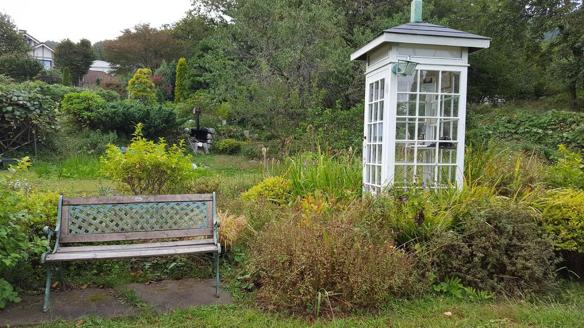
Image: Akira Tana and Otonowa/Sound Circle

Years ago Isaru Sasaki chose his home site on a hill overlooking the sea above Otsuchi, Japan. In 2010, after the death of a beloved cousin, he installed a charming little phone booth in his garden with many-paned glass walls, an Asian peaked green roof, and an old-fashioned dial telephone inside, not connected to any phone line. Sasaki created this as a quiet place to grieve for and connect with his cousin. He called this the Phone of the Wind, because it is the wind that carries his voice.

One year later the earthquake-sourced tsunami that swept through Otsuchi, destroying most of the small fishing village and killing many of its residents, caused a massive meltdown at the Fukushima Daiichi Nuclear Power Plant. When Sasaki’s hilltop home was saved, he offered the use of his phone to grieving villagers or to anyone who yearned to connect with a dead beloved.

At first only villagers came, but soon there were others. One fifteen-year-old boy made a four-hour journey to the booth to talk to his father who had been swept out to sea in the tsunami. A woman whose husband had been killed and their home destroyed, dialed her house number to reach out to him in the booth. She says she felt he was listening. A grandmother, also widowed by the tsunami, continues five years later to use the phone and to bring her grandchildren to speak to their grandfather. One of them says he hears his grandpa’s voice; children can be less reticent than adults to admit such a thing.

Some people speak and hang up. Others await a response. After the teenage boy’s visit, he convinced his siblings and their mother to make the trip. Though this family had been unable to talk about the death of their father and husband, in the garden outside the booth they gather and finally can talk and cry and laugh together about him.

Many people return again and again. Do they receive contact from the person they long to hear from? Are their words heard by the dead? Why do they return so many times? Why do so many of them cry? A forty-nine minute NHK documentary on YouTube (The Phone of the Wind: Whispers to Lost Families [1080p HD]) doesn’t answer these questions. But the faces and body language of people using the Phone of the Wind reveal much and no one in the film walks away looking disappointed.

In the age of cell phones it’s rare to even see a phone booth—but Sasaki’s idea incorporates a basic approach to encouraging contact with our dead beloveds by its focus on a particular place.

For me there are two such places. I linger in bed in the morning (some might say malinger), because I love the hypnopompic space between the world of sleep and dreams and the world of waking. It is here I feel most connected to Spirit and receive answers to questions and solutions to problems. It is also here that I commonly receive contact with my deceased daughter and mother and, occasionally, with others. The second place I am likely to receive contact is my altar which is a place I go every morning and evening to pray and to meditate and to listen inward.

If we long to make connection with someone dear who has died, we can create some version of our own “phone booth.” This spot could be a favorite tree or a sun-warmed rock large enough to lie down on. It could be a candle-lit desk with an open notebook and a pen, or a drafting table with paper and sumi ink or watercolor, someplace quiet we return to regularly, someplace where we don’t expect to be interrupted.

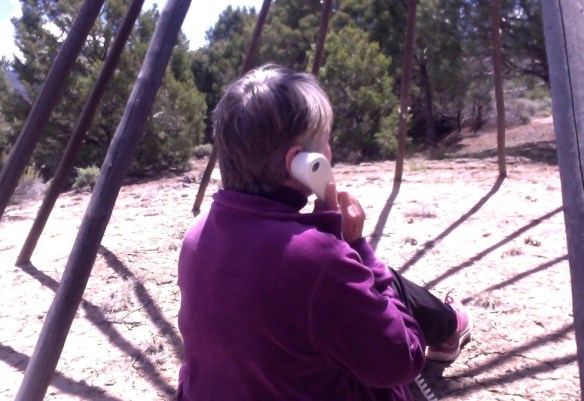
Placing an old phone in our spot could be just the action that gives us permission to speak freely to the dead and to listen for a response. We might be surprised by what happens.

The After Death Chronicles: True Stories of Comfort, Guidance, and Wisdom from Beyond the Veil. To be released October 6, 2017. Watch for pre-ordering in July. www.anniemattingley.com