Unknown's avatar

About anniemattingley

After-Death Communication Researcher, Author and Speaker

Vera, a Mystical Film

Blog. Blogger. Blogging. How many times did I hear these words before I had any clue what they meant? Blog made me think of glop and glop took me back to eggplant glop, the name my family gave to a gooey, cheesy dish my daughters would beg me to make when they were young. Yet here I am writing a new blog every week, so who says an old dog can’t be taught new tricks? I refuse to describe myself as a blogger though, any more than I was a glopper back then.

In the early 2000s, when I first saw the film Vera  (www.facetsdvd.com) presented by its Mexican director Francisco Athie at the Taos Talking Picture Festival, I was mesmerized. This visionary film depicts the journey from life into death of an old Maya man. He is a miner who dies in an accident, though neither the old man nor I realize this for quite some time. Lest he lose his way on his journey, a guide—Vera—appears to escort him across.

Vera is so ethereal, so unearthly it’s difficult to get that she is actually played by the living, breathing Japanese actress and Butoh dancer, Urara Kusanagi, rather than by some being created in an animation department. In a boat that slides silently through underground passages, Vera transports the man from the mine into the land of the dead with the utmost gentleness and love. One could never hope for more supportive assistance.

This is the thrust of the story. You must see the film to feel its magic, the pace slow and lyrical as poetry. It is in Mayan and Spanish. There are English subtitles, but there is so little need for language they seem almost irrelevant.

Though the film is fictional, it aligns perfectly with accounts from the dying and from near-death experiencers. Vera is also reflective of the peace that emits from those dead who communicate through the veil that separates life from death.

I remember how cold my mother’s feet became and then her legs, hours before her last breath. She seemed to die from the toes up. Yet even before that, she lost her desire to open her eyes and look at life, to speak, to drink, to eat. To please my sister, she took one bite of her daughter’s homemade pumpkin mousse on Thanksgiving, but that she did out of love not hunger.

I was interrupted just now by a phone call with the news of the death of a distant relative in her late eighties, who had been failing for a while. She died at home, her family at her bedside. Last week, when she refused dialysis, her dying began in earnest.

Certain doctors, especially those involved in the cutting edge work of resuscitation medicine, are beginning to understand that the body’s last breath is only part of a complex process. Beloveds, as well as hospice workers—nurses, doctors, orderlies, and palliative care therapists alike—get to see before-death experiences where the dying address people unseen by others. Those who die briefly and are resuscitated tell of what lies beyond death. In the middle of this rich texture is that point which modern medicine calls the moment of death.

The whole process, emotionally draining as it usually is for those left behind, is a sacred one, replete with a sense of mystery that Vera ably portrays.

The After Death Chronicles: True Stories of Comfort, Guidance, and Wisdom from Beyond the Veil. To be released October 6, 2017. Pre-order on AmazonBarnes & Noble, and IndieBound. Find out more on my Book Page.
Three Reasons Why After-Death Communication Matters

We humans crave meaning in our lives. Contact with our dead beloveds can fulfill that desire in several manners. The most obvious way is that it relieves grief, but this is not its sole purpose. What I’ve found through my personal experience and research and interviews is that besides offering the bereaved comfort and hope, after-death contact can reduce fear of our own deaths and demonstrate that consciousness continues beyond the grave.

Hearing my daughter’s voice a few weeks after her suicide instantly released the hundred pound sack of worry for her that hung from my heart. She didn’t have to tell me she was okay. The very sound of her voice let me know she was all right.

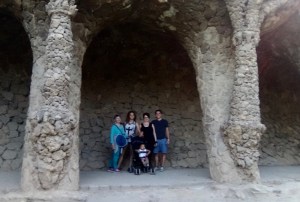
Me and My Family at Park Guell in Barcelona

During the three fabulous weeks I just spent in Spain with my family I saw how often my great-granddaughter cried like she’d lost her forever when her mom left the room. She’s the one in the stroller in the photo taken at Gaudi’s Park Guell in Barcelona.

This is exactly how we react when beloveds die, convinced we will never see them again. Our bodies ache, our hearts break, our minds dull. If we hear or see or feel their presence again, this process is not halted. But if we have some contact through the veil, the edges of our grief can be muted and softened once we grasp that on a non-material basis this person is still available to us.

This realization helps us to deal with a profound mystery: what will happen to us when we die? Most of us range along a continuum from nervous to terrified about that question. Do we simply fall into an abyss of nothingness? Is there a heaven or a hell? Are we worried that our flaws and mistakes will be judged? Will we be “sent” to that heaven or that hell?

Despite all the words of praise spoken in eulogies, our dead beloveds are most likely as imperfect as we are. When they return to tell us they’re okay, sometimes surrounded by a light so transcendent earthly words are inadequate to describe it, it helps us to understand that death is neither an empty abyss nor some horrific place to be feared.

Once we open ourselves to the possibility of death as a continuation, as another kind of existence, we are brought face to face with another large question: Who am I? Because we are so bound to our bodies, we are challenged to understand that we are more than physical beings.

I like to use the word consciousness to describe our essential nature, that part of us that does not die, that cannot die, that existed before birth and will exist after death, that part of us that does not require a physical body in order to be. You may be more comfortable using other words like soul or spirit to describe that essence.

Because I have seen these results manifest so profoundly in those who have had contact with dead beloveds, I view these moments as packed with possibilities. Whether we experience a single instance or, as I have, innumerable contacts, if we are willing to examine and explore the deeper meaning that underlies these experiences, we open ourselves to the mystical realms.

This can add a dimension of satisfaction and joy and relief from anxiety that frees us up to live life more fully. In these three ways—grief relief, less fear of death, and awareness of our essential nature—after-death communication can evolve into one of life’s great gifts.

The After Death Chronicles: True Stories of Comfort, Guidance, and Wisdom from Beyond the Veil. To be released October 6, 2017. Pre-order on AmazonBarnes & Noble, and IndieBound. Find out more on my Book Page.

Grief Poem #5

(inspired by Canto de Obsidiana by Gerardo Suter, MACO exhibit, 2013)

Obsidian Shard

In the length of a phone call
it entered my flesh
pierced my chest through and through
my world torn off its axis
skin, muscle, ventricle, auricle, tissue, vein
penetrated by needle-thin volcanic glass.
I do not make peace with it.
I do not accept it.
There is no resolution, no closure.
I allow. No thing more.
By now its presence is not felt
until the sound of violin, tenor, or harp
splinters its strange reality
and fills me with old shadows.

Afterward, as if melted by memory’s furnace
it re-forms into the most slender of slivers.
In the night, I caress it for comfort.
Like a genie in a bottle
rubbed the right way
it brings the precious history
restores the unbroken umbilical cord.

I begin and begin again
and in her ending my beginning
grows fiercely forward
like the saguaro grows taller, stronger from lack.
I shed my black mourning, receive the sun. 

© creativecommonsstockphotos / Dreamstime Stock Photos

The After Death Chronicles: True Stories of Comfort, Guidance, and Wisdom from Beyond the Veil. To be released October 6, 2017. Pre-order on Amazon, Barnes and Noble, and Indiebound. Find out more on my Book page at www.anniemattingley.com/books

Can We Say the Right Thing?

Someone has died. Perhaps the hardest words to get right are the ones that must be said or written to their beloveds. In fact, we can never get these words right, because they won’t make the pain go away.

After my daughter’s death, going to the grocery store was no easier than standing naked on a pedestal on the plaza would have been. The eyes of strangers drew blood. I was hyper-aware of everyone and it seemed that most everyone—if they already knew—was hyper-aware of me. Mothers, especially, zipped around corners out of sight too often to be coincidental, as if my daughter’s death were contagious.

© creativecommonsstockphotos / Dreamstime Stock Photos

No one knew what to say, least of all me. The first few times I was asked, “Annie, how are you?” and blurted out that my daughter had taken her own life, it was as if I had punched the person in the belly. I learned to soften my words—“She was depressed. She became suicidal.” I watched people guess what I was about to say and prepare themselves.

I felt like a pariah when someone said absolutely nothing when told or, literally, backed away. If someone responded with a flat, “Sorry for your loss,” I felt closed out.

Yet when a woman I knew slightly leaned back against a shelf with a sense that she had all afternoon to listen and asked me, “How are you doing?” I closed her out with a curt, “Pretty well, thanks, and you?” I was impossible to please in those early months, because the wound always remained.

One day I ran into the friend of a friend. We small-talked until that challenging moment when she asked what was happening in my life. I told her gradually. Her eyes widened and welled. Looking shocked, she whispered, “I don’t know what to say.” And—this was key—she did not look away. She was so authentic my heart sprang open. I watched her processing before she continued. Her words, “I am so sorry. How are you doing with it?” were not special, but they were embedded with a level of presence that bathed me like warm oil. We spoke for a long time. I neither pretended to be all right nor broke down.

Our words can be simple if we allow them to arise without censorship. This woman was not afraid to express her natural response or to give herself time to deal with her own emotions. Because she was present with herself, she could be present with me and we could connect. Of course, there was timing too; I was in the right place to be authentic with her.

The timing of nearly all deaths disturbs, with the young, even more so. But our current cultural practices teach us that death is the enemy. We struggle to extend life at nearly any cost. We whisk bodies away to funeral homes as if they were too ugly to look upon until coiffed and made up. We are tongue-tied in the presence of grief and the bereaved. I respect words beyond measure, but I understand their limitations.

Perhaps the most significant action in the face of a person in grief is to feel our own pain and fears and to let this shine through our eyes and to allow our words to be the feeble and limited expressions they are. It is our body language, the looks on our faces and in our eyes that matter.

Saying the wrong thing may be less important than trying too hard to say the right thing.

The After Death Chronicles: True Stories of Comfort, Guidance, and Wisdom from Beyond the Veil. To be released October 6, 2017. Watch for pre-ordering in July.
www.anniemattingley.com

Does Death Transform Us?

Whatever else occurs in the mystery that is the afterlife, growth is a key aspect.

A year following his death, Helena’s father, too reserved to be close to his daughter when alive, sat down beside her in a dream. He had two forms. He was both himself (so she recognizes him) and a huge white mountain. She knew that his true form was the mountain. When he told her not to worry—about him or about anything, she was filled with ecstasy. This replaces everything between them, she told me, and is the “true nature of our relationship.”

© creativecommonsstockphotos / Dreamstime Stock Photos

Something happens when we are no longer in our bodies, no longer stuck in the negative aspects of our personalities. The dead mature, African shaman Mandaza Augustine Kandemwa says, in the book Twin from Another Tribe, he co-authored with Michael Ortiz Hill.

Many of those I interviewed during the research for my book on after-death communication experienced contact with the dead who had shifted from belligerence, rage, or alcoholism into benevolent and loving parents or siblings or partners. Forgiveness arose. Selfishness fell away, though sometimes this took years. An abusive father came in a dream long after death, ready to support his daughter for the first time and expressing his admiration for her.

At times this transformation must occur within the living too. My parents died in 1984. Large components of healing occurred among us just before their deaths, but I clung to certain resentments. Gradually, as I matured, these faded, so that now I feel only enormous appreciation for their gifts; their human flaws seem negligible.

For fifteen years Carla’s father’s Alzheimer’s had kept her from receiving the emotional support she longed for. She scheduled a psychic reading when she had no idea he would soon die. Her session, after his death, was flooded with his presence and support and love. After that, as though his dementia had never been, his reassurance and advice seemed always available to her. He helped her with issues involving her divorce; complex situations were resolved just as he said they would be. Carla told me her father gave her “the strength and perspicacity to do what I needed to do.”

Dementia and diseases like Alzheimer’s are of the physical body and brain. Once they are out of the picture, the essential nature is free to rise.

This quality of our true nature that emerges after death is best summed up with the single word “loving”. We humans can be quick to anger, to judge, to resent, and to wound those we love the most. The nature of loving in the afterlife, as indicated by both after-death communication and near-death experiences, excludes anger, judgment, resentment, and hurt. Only love matters to them now. Anything else is “nothing more than a row of pins” as one deceased husband told his wife when she worried about something she had done.

It is nearly universal for any direct connection with the afterlife to demonstrate this absolute and unqualified love. In fact, these visceral demonstrations of untainted love may be the primary gift of our contact with the dead.

Reading or talking about unconditional love is not the same as feeling its effects. Our response to such love is like a thirsty plant’s response to warm rain. We flourish under its presence and we are taught how to live and love more fully with each contact.

The After Death Chronicles: True Stories of Comfort, Guidance, and Wisdom from Beyond the Veil. To be released October 6, 2017. Watch for pre-ordering in July.
www.anniemattingley.com